×
‹
![]() ›
›
BIBLICAL ROUTE THROUGH TURKEY – FOLLOWING IN THE FOOTSTEPS OF SAINT PAUL
Istanbul · Antioch (Hatay) · Tarsus · Cappadocia · Antioch in Pisidia · Pamukkale · The Seven Churches of the Apocalypse · Troy · Nicaea and more
GROUP TYPE
PRIVATE TOUR
DURATION
14 DAYS / 13 NIGHTS
HOTELS
Category 4 - 5 ★
DAY BY DAY ITINERARY
BREAKFAST
Not included
LUNCH
Not included
DINNER
Not included
- Welcome to Turkey, a land where history, faith, and culture have been intertwined for thousands of years. Upon arrival at Istanbul International Airport (IST) or Sabiha Gökçen Airport (SAW), our Spanish-speaking representative will greet you with a personalized sign and accompany you on a private transfer to your hotel.
- Istanbul, the ancient Constantinople, is the gateway to one of the most fascinating biblical pilgrimages in the world. Although today it is a modern metropolis, for centuries it was the heart of Eastern Christianity and the seat of the Byzantine Empire.
- From here we begin an extraordinary journey through the places where Saint Paul, Saint Peter, Saint John, and the first disciples of Christ preached.
- This extraordinary biblical pilgrimage will take us through the places where Saint Paul, Saint Peter, and Saint John the Evangelist preached, visiting the Seven Churches of the Apocalypse, the cities mentioned in the New Testament, and some of the most important settings of the Early Church.
- Rest of the day at leisure to rest and prepare for this unforgettable Biblical Route through Turkey.
- Overnight in Istanbul.
BREAKFAST
Breakfast included at the hotel
LUNCH
Not included
DINNER
Dinner included at the hotel
- After breakfast, we begin our pilgrimage through the heart of ancient Constantinople, one of the most important cities in the history of Christianity. For over a thousand years it served as the capital of the Byzantine Empire and the main political, religious, and cultural center of Eastern Christianity.
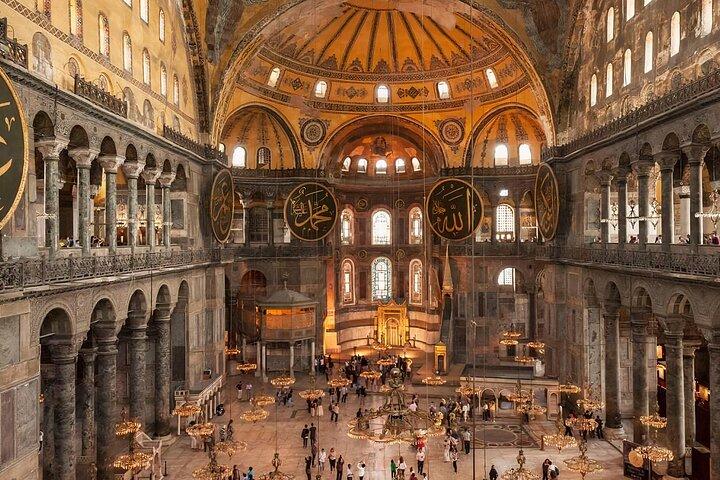
- Our first visit is the magnificent Hagia Sophia, one of the masterpieces of world architecture. Built by Emperor Justinian I in 537 AD, for nearly a millennium it was the largest cathedral in the Christian world. Here imperial coronations, important religious ceremonies, and events that shaped Church history took place. Its immense dome, Byzantine mosaics, and extraordinary architecture continue to awe millions of pilgrims and visitors from around the world.
- We continue to the historic Hippodrome of Constantinople, the ancient social and political center of the Byzantine Empire. Thousands would gather here to witness chariot races and take part in imperial celebrations. During the visit we can admire the Obelisk of Theodosius, the Serpentine Column, and the German Fountain, monuments that recall the splendor of the ancient imperial capital.
- A short walk brings us to the impressive Blue Mosque, famous for its six minarets and spectacular interior with more than twenty thousand İznik tiles. Although it belongs to the Ottoman period, it is one of Istanbul's most iconic monuments and reflects the city's rich historical and cultural heritage.
- We conclude at the legendary Grand Bazaar, one of the oldest and largest covered markets on the planet. With more than four thousand shops, this place has for centuries been an important meeting point for merchants from Europe, Asia, and the Middle East.
- After the visits, return to the hotel.
- Dinner and overnight in Istanbul.
BREAKFAST
Breakfast included at the hotel
LUNCH
Not included
DINNER
Dinner included at the hotel
- After an early breakfast, transfer to the airport for a domestic flight to Hatay, the ancient Antioch on the Orontes, considered one of the most important places in the entire history of Christianity.
- Antioch was one of the great centers of the Early Church and played a decisive role in the expansion of the Gospel. According to the Acts of the Apostles (11:26), it was here that, for the first time, the disciples of Jesus were called "Christians."
- We visit the historic Grotto of Saint Peter, considered by tradition to be one of the first gathering places of Christ's followers. In this place the early Christians held their meetings and prayers while suffering persecution.
- We recall that from Antioch, Saint Paul and Saint Barnabas began their great missionary journeys that would transform the history of Christianity. From this city Saint Paul and Silas also set out on the Second Missionary Journey (Acts 15:35-41), carrying the Gospel message to Asia Minor and later to Europe.
- During the visit we also discover the enormous spiritual influence of important Church Fathers such as Saint Ignatius of Antioch, one of the first Christian bishops and a martyr of the 1st century, and Saint John Chrysostom, one of the greatest preachers in Christianity. Acts 2:9 also mentions pilgrims from Cappadocia present in Jerusalem on the day of Pentecost, when they received the Holy Spirit and heard Saint Peter's preaching, likely becoming some of the first evangelizers of Anatolia.
- After the visits, we continue by road to Adana.
- Dinner and overnight in Adana.
BREAKFAST
Breakfast included at the hotel
LUNCH
Not included
DINNER
Dinner included at the hotel
- After breakfast, we head to Tarsus, birthplace of the Apostle Saint Paul, one of the most influential figures in the entire history of Christianity. Here was born Saul of Tarsus, a Roman citizen, Pharisee, and later the great missionary who would carry the Gospel to Asia Minor, Greece, and Rome. His letters form an essential part of the New Testament and continue to be a source of inspiration for millions of Christians.
- We visit the traditional Well of Saint Paul, venerated by pilgrims for centuries, as well as the historic Cleopatra's Gate, one of the city's most iconic monuments.
- We also discover the latest archaeological excavations that reveal Tarsus's importance during the Roman era.
- We then continue to the spectacular region of Cappadocia, one of the most impressive natural wonders in the world.
- Our first visit is the Underground City of Kaymakli, where thousands of Christians found refuge during the Roman persecutions and subsequent invasions. This extraordinary rock-carved complex has churches, wine cellars, kitchens, storerooms, and tunnels that allowed the first Christian communities to survive for extended periods underground.
- The day concludes with arrival at our hotel in Cappadocia.
- Dinner and overnight in Cappadocia.
BREAKFAST
Breakfast included at the hotel
LUNCH
Not included
DINNER
Dinner included at the hotel
- After breakfast, we begin our full-day tour of Cappadocia, one of the most extraordinary regions of Turkey and one of the most important places in the history of early Christianity. Declared a UNESCO World Heritage Site, Cappadocia amazes with its volcanic landscapes, underground cities, and rock-carved churches. Although famous for its spectacular Fairy Chimneys, Cappadocia also holds immense spiritual value.
- During the first centuries of Christianity, thousands of believers found refuge in this region to escape Roman persecutions. Here numerous monastic communities flourished and great Church figures emerged, such as Saint Basil the Great, Saint Gregory of Nyssa, and Saint Gregory of Nazianzus, known as the Cappadocian Fathers, who were fundamental in formulating Christian doctrine and the Nicene Creed.
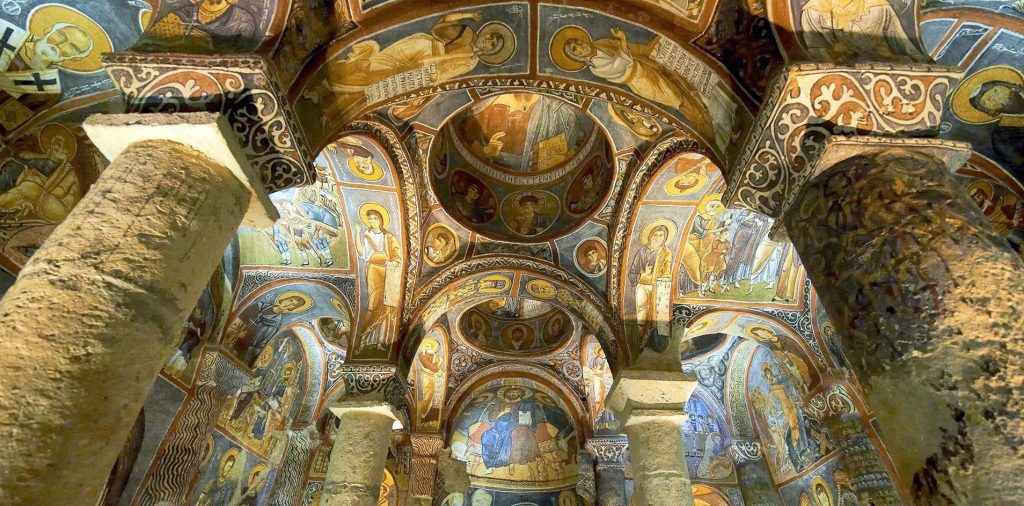
- Our first visit is the Göreme Open-Air Museum, one of the most important monastic complexes in the Christian world. Its churches, chapels, and monasteries carved in the rock preserve impressive Byzantine frescoes from the 10th to 13th centuries depicting scenes from the life of Christ, the Virgin Mary, and numerous saints.
- We continue to Pasabag Valley, famous for its unique volcanic formations known as Fairy Chimneys, where the first hermits built small chapels and refuges to devote themselves to prayer and contemplative life.
- We then visit Avanos, a city on the banks of the Kızılırmak River, known since Hittite times for its pottery tradition. Here we discover artisanal techniques passed down for over four thousand years.
- We conclude at the impressive Uchisar Castle, the highest point in Cappadocia, from where we enjoy a panoramic view of the valleys and ancient Christian settlements that shaped the religious history of Anatolia.
- Dinner and overnight in Cappadocia.
BREAKFAST
Breakfast included at the hotel
LUNCH
Not included
DINNER
Dinner included at the hotel
- After breakfast, we begin our journey along the historic Silk Road. Our first stop is the magnificent Sultanhani Caravanserai, built in the 13th century by the Seljuks. This impressive building provided shelter to merchants and pilgrims traveling between East and West, becoming a symbol of cultural and religious exchange during the Middle Ages.
- We continue to Lystra, a city closely linked to Saint Paul's Missionary Journeys. According to the Acts of the Apostles (14:6-20), it was here that the Apostle performed the miracle of healing a man lame from birth. The inhabitants, impressed by the miracle, believed that Paul and Barnabas were gods descended from Olympus. However, shortly after, a crowd stirred up by their opponents stoned Saint Paul and left him for dead outside the city. He miraculously survived and continued to proclaim the Gospel. Lystra also holds special significance because it was here that Paul met Timothy, one of his most beloved disciples and later Bishop of Ephesus, who joined his missionary team during the Second Missionary Journey (Acts 16:1-3).
- Our next stop is Iconium, present-day Konya, another city deeply connected to Saint Paul's preaching. In Acts 14:1-6, Paul and Barnabas proclaimed the Gospel in the synagogue of Iconium, achieving many conversions among both Jews and Gentiles. Konya is also known as the city of Mevlana Jalaluddin Rumi, founder of the Order of the Whirling Dervishes.
- We visit the Mevlana Museum, one of the most revered places in Turkey, before transferring to the hotel.
- Dinner and overnight in Konya.
BREAKFAST
Breakfast included at the hotel
LUNCH
Not included
DINNER
Dinner included at the hotel
- After breakfast, we head to Antioch in Pisidia, one of the most important places on the Biblical Route of Saint Paul. It was here that the Apostle delivered one of his most celebrated sermons during the First Missionary Journey (Acts 13:14-52). In the city's synagogue he announced that Jesus Christ was the Messiah awaited by Israel, making a profound impact. We visit the important archaeological excavations, including the Basilica of Saint Paul, the Temple of Augustus, the theater, the colonnaded streets, and the remains of the ancient Roman city.
- We then travel along part of the legendary Persian Royal Road, one of the oldest trade routes in the world, connecting Ephesus with Babylon and facilitating for centuries the spread of commerce, cultures, and later Christianity.
- Our next stop is Colossae, a city near the Lycus River known for Saint Paul's Letter to the Colossians. Colossae was one of the first Christian communities evangelized by Epaphras, a close collaborator of Saint Paul. In his letter, the Apostle proclaims the supremacy of Christ over all creation (Colossians 1:15-20), a fundamental text for Christian theology.
- Finally, we arrive at Hierapolis-Pamukkale, one of Turkey's most spectacular natural landscapes. Its famous white travertine terraces formed by thermal waters gave it the name 'Cotton Castle.' Hierapolis was one of the main Christian centers in the Lycus Valley and, according to tradition, the Apostle Saint Philip was martyred here.
- Dinner and overnight in Pamukkale.
BREAKFAST
Breakfast included at the hotel
LUNCH
Not included
DINNER
Dinner included at the hotel
- After breakfast, we continue our Biblical Pilgrimage through Turkey, visiting three of the Seven Churches of the Apocalypse mentioned by Saint John the Evangelist in the last book of the New Testament.
- Our first visit is Laodicea, one of the richest and most influential cities in the Roman Empire during the 1st century. In the Book of Revelation (3:14-22), Saint John conveys the celebrated message: "Because you are neither cold nor hot... I will spit you out of my mouth."
- We continue to Philadelphia (Alaşehir), one of the two churches that received only words of praise in the Book of Revelation (Revelation 3:7-13). Saint John presents this community as an example of faithfulness, perseverance, and trust in Christ.
- Our next stop is Sardis, the ancient capital of the powerful Kingdom of Lydia and another of the Seven Churches of the Apocalypse (Revelation 3:1-6). Sardis was one of the richest cities in the ancient world, famous for King Croesus and the gold trade.
- After the visits, we continue to Izmir (Smyrna), where Saint Polycarp, a direct disciple of Saint John the Evangelist and one of the most important Apostolic Fathers, carried out his ministry.
- Dinner and overnight in Izmir.
BREAKFAST
Breakfast included at the hotel
LUNCH
Not included
DINNER
Dinner included at the hotel
- After breakfast, we head to Miletus, one of the most important cities of ancient Ionia and one of the main settings of Saint Paul's Missionary Journeys. Miletus was the birthplace of the philosopher Thales, considered the father of Greek philosophy.
- For Christians, Miletus holds a very special place because here Saint Paul, during his Third Missionary Journey, gathered the elders of the Church of Ephesus and delivered one of the most moving speeches in the New Testament (Acts 20:17-38). Aware that he would probably not see them again, the Apostle encouraged them to care for the flock God had entrusted to them and reminded them that "it is more blessed to give than to receive." It was also in Miletus that Paul left his co-worker Trophimus, who was sick, before continuing to Jerusalem (2 Timothy 4:20).
- We visit the magnificent Grand Theater (capacity 15,000), the baths, the agora, and the main streets of the city.
- We continue to Didyma, one of the most important religious centers in the Greek world, where the monumental Temple of Apollo stood. The visit to Didyma allows us to understand the pagan religious context the first Christian missionaries faced.
- We then continue to Kuşadası, a beautiful city on the Aegean Sea.
- Dinner and overnight in Kuşadası or Izmir.
BREAKFAST
Breakfast included at the hotel
LUNCH
Not included
DINNER
Dinner included at the hotel
- After breakfast, we visit Ephesus, considered the most important city of early Christianity in Asia Minor and one of the Seven Churches of the Apocalypse. In Revelation 2:1-7, Christ acknowledges the perseverance of the Church of Ephesus but invites it to recover its first love.
- Ephesus was where Saint Paul spent nearly three years during his Third Missionary Journey, making it the main center of evangelization in Asia Minor. We explore the ancient city, visiting the Library of Celsus, the impressive Grand Theater where the famous riot caused by the silversmiths of the Temple of Artemis took place (Acts 19), the Marble Street, the Temple of Hadrian, the Roman baths, and the ancient commercial streets.
- We then visit the House of the Virgin Mary, where, according to Christian tradition, Mary spent her final years under the care of the Apostle Saint John (John 19:26-27). This Marian shrine has been visited by Saint Paul VI, Saint John Paul II, Benedict XVI, and Pope Francis.
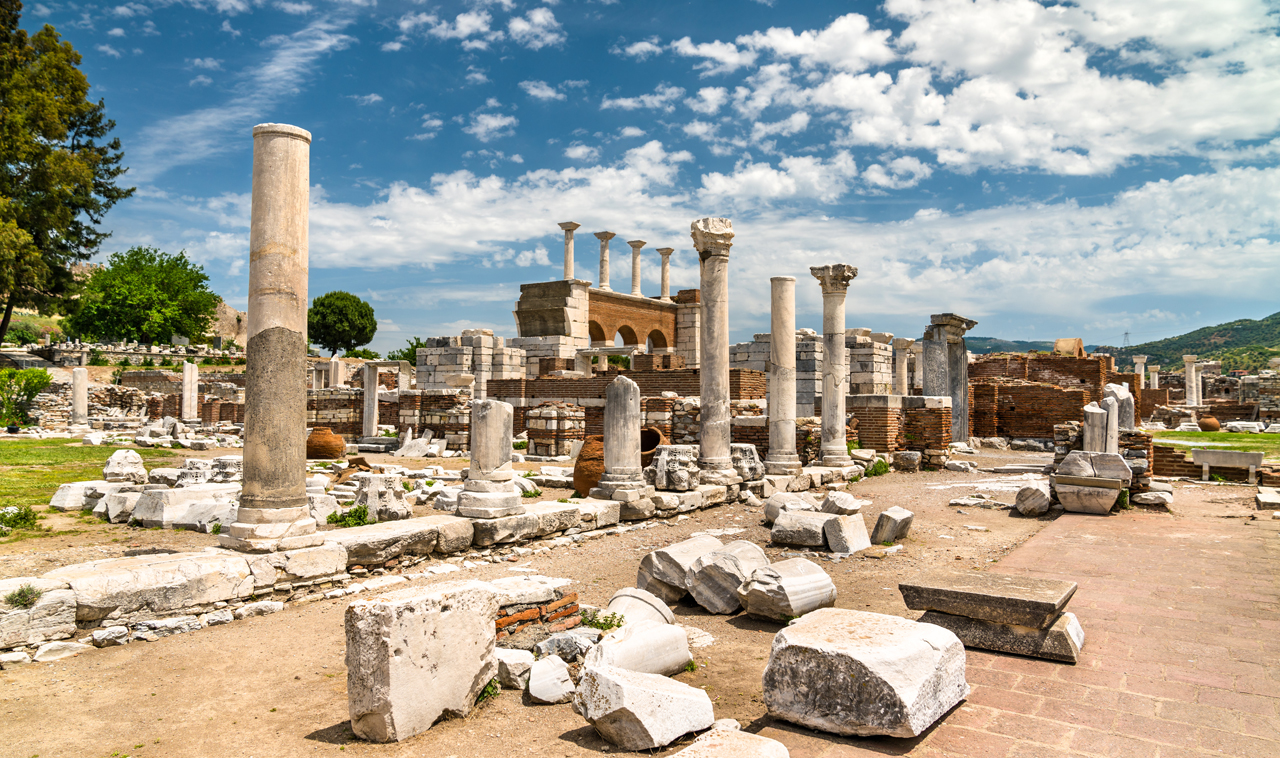
- We conclude at the Basilica of Saint John, built by Emperor Justinian over the Apostle's tomb. We also contemplate the remains of the Temple of Artemis, one of the Seven Wonders of the Ancient World.
- Dinner and overnight in Kuşadası or Izmir.
BREAKFAST
Breakfast included at the hotel
LUNCH
Not included
DINNER
Dinner included at the hotel
- After breakfast, we head to Thyatira (Akhisar), one of the Seven Churches of the Apocalypse. In Revelation 2:18-29, Christ addresses a community recognized for its love, faith, service, and perseverance, yet exhorts it to remain firm against false teachings. Thyatira was a prosperous commercial city, and it was here that Lydia was born — a seller of purple cloth who became the first Christian in Europe after hearing Saint Paul preach in Philippi (Acts 16:11-15).
- We continue to Pergamon, one of the most important cities of Roman Asia Minor and one of the Seven Churches of the Apocalypse. In Revelation 2:12-17, Christ describes Pergamon as "the place where Satan's throne is," a reference many scholars associate with the monumental Altar of Zeus and the imperial cult.
- We explore the spectacular Acropolis, the Grand Theater, the Temple of Trajan, the remains of the Altar of Zeus, and the famous Asclepion, one of the most important medical centers of Antiquity.
- We also visit the impressive Red Basilica, originally built as a temple for Egyptian gods and later transformed into a Christian church. Here we recall the testimony of Saint Antipas, the first martyr of this Church, mentioned by Saint John as an example of faithfulness to Christ.
- Dinner and overnight in Pergamon.
BREAKFAST
Breakfast included at the hotel
LUNCH
Not included
DINNER
Dinner included at the hotel
- After breakfast, we travel to Assos, a beautiful city situated on the Aegean. It was here that Saint Paul reunited with his companions during his Third Missionary Journey, after walking alone from Troas (Acts 20:13-14). We stroll through the ancient market, admire the walls, and visit the magnificent Temple of Athena with its spectacular Aegean views.
- We continue to Alexandria Troas, a city founded by one of Alexander the Great's generals. Troas holds a very special place in the history of Christianity: here Saint Paul received the vision of the Macedonian man who pleaded "Come over to Macedonia and help us" (Acts 16:9), marking the beginning of the evangelization of Europe. Also in Troas, the young Eutychus fell from a window while listening to Saint Paul and was miraculously restored to life (Acts 20:7-12).
- Our pilgrimage continues to the legendary city of Troy, a UNESCO World Heritage Site universally known through Homer's Iliad. Although Troy is not directly related to biblical history, it is one of the most important archaeological sites in the world.
- Arrival in Çanakkale.
- Dinner and overnight in Çanakkale.
BREAKFAST
Breakfast included at the hotel
LUNCH
Not included
DINNER
Dinner included at the hotel
- After breakfast, we set out for Nicaea (İznik), one of the most important cities in the entire history of Christianity.
- Nicaea holds a unique place because here, in 325 AD, the First Ecumenical Council was held, convened by Emperor Constantine the Great. During this historic event, bishops from throughout Christendom formulated the Nicene Creed, the foundation of Christian faith that continues to be proclaimed by millions of believers around the world.
- We visit the remains of the ancient imperial palace by Lake İznik, where the Council of Nicaea took place. We then discover the historic Church of Hagia Sophia of Nicaea, the setting of the Seventh Ecumenical Council held in 787 AD, during which the veneration of icons was officially restored within the Church.
- We visit the historic Basilica of Hagia Sophia of Nicaea, built in the 6th century by order of Emperor Justinian. According to tradition, the Second Council of Nicaea was held here in 787 AD, during which the Church resolved the iconoclastic controversy and reaffirmed the value of sacred images in Christian life.
- After the visit, we continue to Istanbul, traveling through the landscapes of northwestern Anatolia while recalling the extraordinary spiritual and historical legacy discovered throughout this pilgrimage.
- Arrival in Istanbul and free time to enjoy the final hours in the city or to do some last-minute shopping.
- Dinner and overnight in Istanbul.
BREAKFAST
Breakfast included at the hotel
LUNCH
Not included
DINNER
Not included
- After breakfast, free time until the indicated time for private transfer to Istanbul International Airport (IST) or Sabiha Gökçen Airport (SAW).
- As this unforgettable pilgrimage comes to an end, we hope that this journey through Biblical Turkey has been much more than a trip. Our wish is that each city visited, each church, each archaeological site, and each holy place has allowed you to deepen your knowledge of the Holy Scriptures and to strengthen your faith following in the footsteps of Saint Paul, Saint Peter, Saint John the Evangelist, and the first Christian communities.
- At Rutas Bíblicas by Turquesa Tours we believe that a pilgrimage is an experience of spiritual transformation, where history, archaeology, and faith come together to bring us closer to the origins of Christianity.
- We sincerely thank you for placing your trust in our team to accompany you on this journey through the places where the Early Church was born and grew. It has been a true honor to be part of this path of faith.
- We hope to welcome you again soon on a new pilgrimage through Turkey, Greece, Egypt, Jordan, or the Holy Land, discovering together the most important settings of biblical history.
- RUTAS BÍBLICAS BY TURQUESA TOURS
- Following in the Footsteps of Faith
| INCLUDED SERVICES |
|---|
|
| EXCLUDED SERVICES |
|---|
|
SHORT ITINERARY
| Day | Night |
|---|---|
| 1 | ARRIVAL IN ISTANBUL, THE ANCIENT CONSTANTINOPLE |
| 2 | HISTORIC ISTANBUL, CRADLE OF BYZANTINE CHRISTIANITY |
| 3 | ISTANBUL – ANTIOCH (HATAY), WHERE THE NAME "CHRISTIANS" WAS BORN – ADANA |
| 4 | TARSUS, BIRTHPLACE OF SAINT PAUL – CAPPADOCIA, THE GREAT REFUGE OF THE FIRST CHRISTIANS |
| 5 | CAPPADOCIA, LAND OF THE FIRST CHRISTIANS |
| 6 | SULTANHANI – LYSTRA – ICONIUM (KONYA), THE STEPS OF SAINT PAUL'S FIRST MISSIONARY JOURNEY |
| 7 | ANTIOCH IN PISIDIA – COLOSSAE – PAMUKKALE, THE FIRST STEPS OF EVANGELIZATION IN ASIA MINOR |
| 8 | LAODICEA – PHILADELPHIA – SARDIS – IZMIR (SMYRNA), THREE OF THE SEVEN CHURCHES OF THE APOCALYPSE |
| 9 | MILETUS – DIDYMA – KUSADASI, IN THE FOOTSTEPS OF SAINT PAUL ALONG THE AEGEAN COAST |
| 10 | EPHESUS – HOUSE OF THE VIRGIN MARY – BASILICA OF SAINT JOHN, THE HEART OF CHRISTIANITY IN ASIA MINOR |
| 11 | IZMIR (SMYRNA) – THYATIRA – PERGAMON, THE FAITHFUL CHURCHES OF THE APOCALYPSE |
| 12 | ASSOS – ALEXANDRIA TROAS – TROY – ÇANAKKALE, SAINT PAUL'S LAST STEPS IN ASIA MINOR |
| 13 | ÇANAKKALE – NICAEA (İZNİK) – ISTANBUL, THE LEGACY OF THE FIRST ECUMENICAL COUNCIL |
| 14 | DEPARTURE FROM ISTANBUL |
HOTELS
| Days | City | Nights | Category / Hotels or similar |
|---|---|---|---|
| 1-2 | Istanbul | 2 nights | Hotel 5★ — Grand Harilton Hotel or similar |
| 3 | Adana | 1 night | Hotel 5★ — Ramada Hotel or similar |
| 4-5 | Cappadocia | 2 nights | Hotel 5★ — Ramada Hotel or similar |
| 6 | Konya | 1 night | Hotel 5★ — Selcuk Hotel or similar |
| 7 | Pamukkale | 1 night | Hotel 5★ — Adempira Thermal Hotel or similar |
| 8-9-10 | Izmir | 3 nights | Hotel 5★ — Greymark Hotel or similar |
| 11 | Pergamon | 1 night | Hotel 5★ — Berksoy Hotel or similar |
| 12 | Çanakkale | 1 night | Hotel 5★ — Parion Hotel or similar |
| 13 | Istanbul | 1 night | Hotel 5★ — Grand Harilton Hotel or similar |
| — | TOTAL | 13 nights | 14 DAYS / 13 NIGHTS |
TRANSFER SUMMARY
| Transfer | Distance | Approx. Time |
|---|---|---|
| Antioch (Hatay) → Adana | ~ 190 km | ~ 2.5 h |
| Adana → Cappadocia | ~ 270 km | ~ 4 h |
| Cappadocia → Konya | ~ 250 km | ~ 3 h |
| Konya → Pamukkale | ~ 400 km | ~ 5.5 h |
| Pamukkale → Izmir | ~ 250 km | ~ 3 h |
| Izmir → Pergamon | ~ 110 km | ~ 1.5 h |
| Pergamon → Çanakkale | ~ 210 km | ~ 2.5 h |
| Çanakkale → Istanbul | ~ 310 km | ~ 4.5 h |
Request a quote for this tour
Complete the form and we will send you a detailed itinerary and a personalized proposal.